What is actually on the table
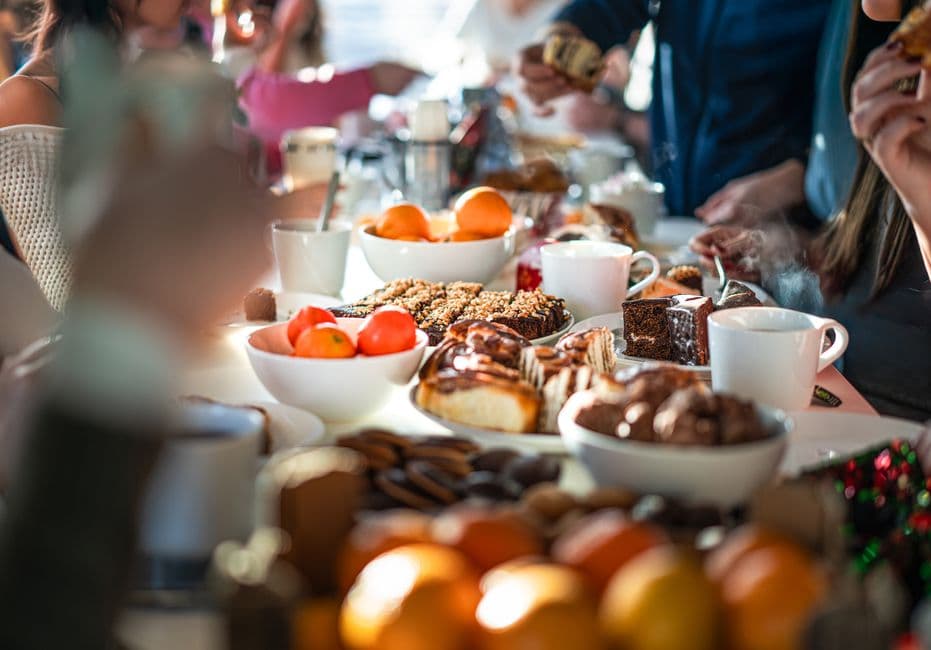
A French office breakfast is built around viennoiserie: croissants, pains au chocolat, and usually a third item such as a pain aux raisins or a brioche. Add bread with butter and jam, fresh fruit, fruit juice, and hot drinks served from insulated flasks.
What is not there, unless you ask: eggs, bacon, sausages, pancakes, and anything served hot on a plate. A cooked breakfast is not part of the French corporate repertoire, and a room of French colleagues will find a tray of scrambled eggs at 08:30 genuinely surprising.
Savoury items do exist and are increasingly common for longer mornings: mini sandwiches, savoury cakes, and occasionally hard-boiled eggs. They are an addition to the standard spread rather than the core of it, and they change the quantities of everything else.
Quantities per person
Light welcome, twenty to thirty minutes before a meeting: one and a half to two pastry items per person, one and a half hot drinks, 15 cl of juice, water, and fruit to share.
Full breakfast, a genuine hour-long moment: two to two and a half pastry items, one to two savoury items, one to one and a half portions of fruit, a yoghurt, bread, two hot drinks and 20 cl of juice.
The adjustment that people forget: if you add savoury items, reduce the pastries to about one and a half per person. Guests spread their appetite across what is offered, and an untouched third of the pastry tray is the visible result of not making that adjustment.
Tell us the headcount and the time the meeting starts, and we will deliver before your guests arrive.
Order a breakfast →Hot drinks, and the coffee question
Allow one and a half to two cups per person, at roughly 20 cl per cup. A one-litre flask therefore serves about five cups. For twelve people, plan on around twenty cups in total across coffee and tea.
Reserve about a third of the hot volume for tea and herbal infusions. The proportion of people not drinking coffee is higher than most ordering plans assume, and running out of tea at 09:00 is an avoidable annoyance.
French corporate coffee is served in small cups and is stronger than American filter coffee. If your team is used to large mugs of filter, say so when you order: it is a straightforward adjustment, and it is the single most common comment from visiting American colleagues.
Timings and delivery
Delivery is scheduled between 07:30 and 09:30, ready to place before the first guest arrives, on-site set-up optional. For an 08:30 welcome, aim for a delivery window that closes at 08:15, which leaves time for the set-up to be finished rather than watched.
Order 24 hours ahead for standard menus, 48 hours from one hundred guests. The lead time runs in calendar hours, weekends included, so a Monday breakfast is ordered over the weekend at the latest, not on Monday morning.
Somebody at your end needs to be present and reachable at the delivery time. A breakfast delivery arriving at a reception desk that opens at 09:00 is the classic Paris failure mode.
Making it work for an international team
Add fruit and a yoghurt option. The pastry-only breakfast reads as generous to a French team and as unbalanced to a Northern European or North American one. Fruit closes that gap at very little cost.
Label anything containing pork, alcohol or nuts. In an international office this is not a nicety, it is the difference between people eating and people politely not eating.
If the breakfast opens a meeting with guests who have travelled, scale up. People arriving off an early Eurostar or a 06:00 flight have not eaten, and the standard light welcome disappears in fifteen minutes.